ISO 45010 Explained
October 12, 2026 • 5 MIN READ
On September 7, 2026, the International Organization for Standardization published ISO 45010 — Occupational health and safety management: Menstruation and menopause in the workplace — Guidance, the world's first international standard on the subject. For Philippine employers, this isn't an abstract global development. With 21.9 million Filipino women in the labor force, most working through the exact life stages ISO 45010 addresses, this is a workplace policy question that's arrived on HR's desk whether or not it was on the roadmap. Here's what the standard actually says, whether it's a legal requirement, and how to act on it.
What Is ISO 45010?
ISO 45010 is a 58-page guidance document developed by ISO/TC 283, the same technical committee behind ISO 45001 (occupational health and safety management systems). It gives organizations of any size or sector a framework for building policies and practices that support workers' menstrual and menopausal health at work — covering areas like facilities, uniforms, attendance policies, manager training, and recruitment practices. Importantly, it explicitly does not provide medical guidance or diagnose anything: it treats menstruation and menopause as normal life-course experiences, not medical conditions, and directs readers to qualified clinical sources for health questions. It's a companion document to ISO 45001, not a replacement for it.
Is ISO 45010 a legal requirement in the Philippines?
No — ISO 45010 is voluntary guidance, not a certifiable requirement or a Philippine law. There is currently no national statute mandating menstrual- or menopause-specific leave in the Philippines. That said, existing frameworks can still apply once symptoms intersect with safety or dignity at work: the Occupational Safety and Health Standards Law (RA 11058), the Magna Carta of Women (RA 9710), and the Safe Spaces Act (RA 11313) all create obligations around safe, non-discriminatory working conditions that menstrual- or menopause-related accommodations can fall under. ISO 45010 itself makes the same point: even where no adjustment is legally mandated by name, associated symptoms can still be covered by existing equality or OSH legislation. Treat ISO 45010 as the practical "how" for policies your existing legal obligations may already imply — and have your counsel confirm how it maps onto your specific risk exposure.
Why should Filipino employers care right now?
The business case isn't hypothetical. A 2024 study in the Philippine Journal of Obstetrics and Gynecology, conducted in a community sample in Paete, Laguna, found that nearly 32% of Filipino perimenopausal women aged 43–48 reported that menopausal symptoms negatively affected their quality of life — with the physical and vasomotor domains hit hardest. Meanwhile, Philippine Statistics Authority labor force data shows 21.9 million women, or 56.27% of the eligible female population, were participating in the Philippine labor force as of December 2023. And separately, the Workplace Happiness Index: Philippines 2025 from Jobstreet by SEEK found that nearly four in ten Filipino Gen Z employees say they often dread going to work — a retention red flag that inclusive, evidence-based workplace policy can help address. Put together: a large and growing share of your female workforce is navigating menstrual or menopausal symptoms with little formal support, at the same time younger talent is actively evaluating employers on exactly this kind of inclusion.
What practical workplace adjustments does ISO 45010 recommend?
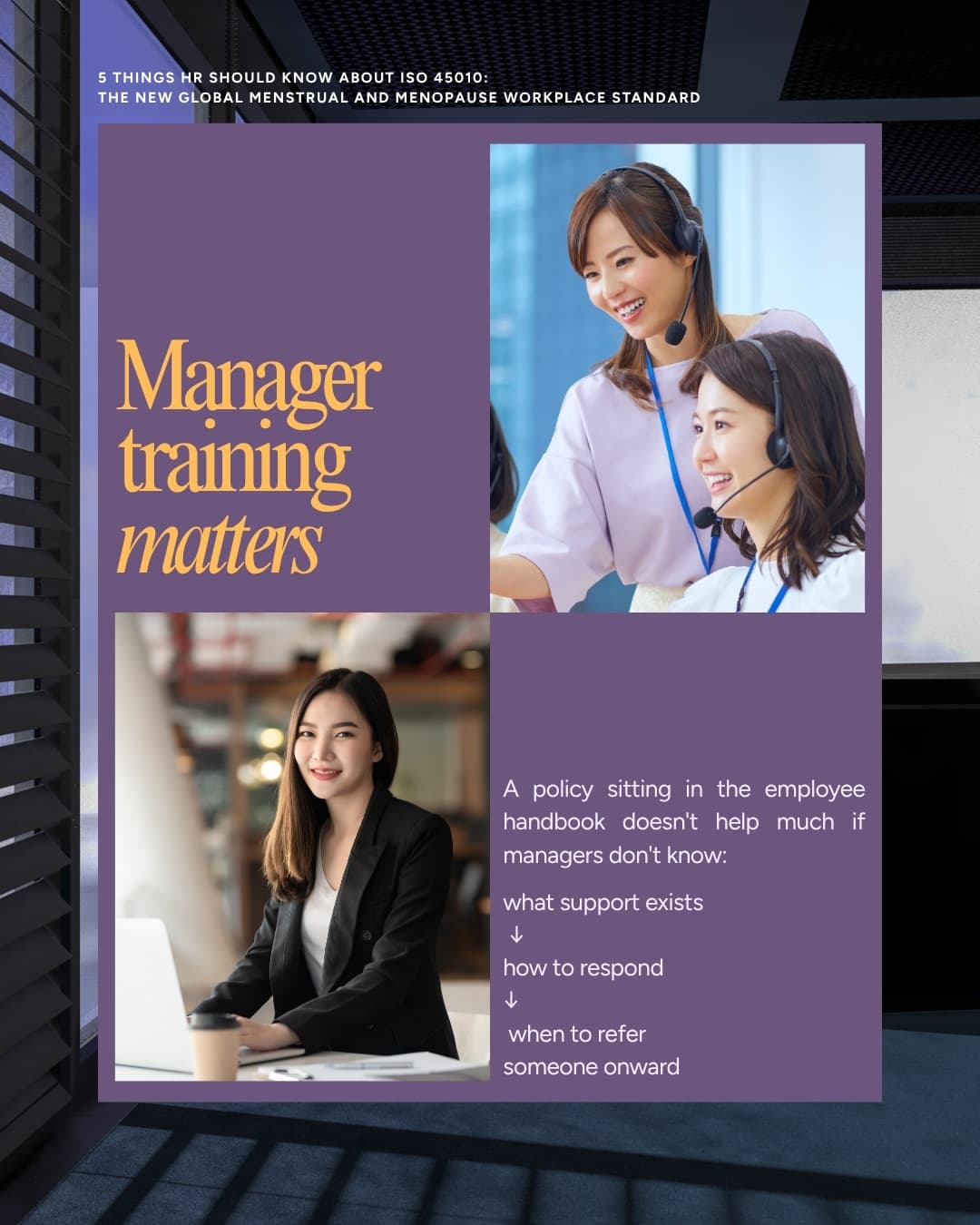
The standard's guidance is deliberately practical rather than prescriptive. It recommends employers work through a sequence: first audit what support already exists; then establish a formal, recognized channel for workers to raise menstrual or menopausal concerns without needing to disclose more than they're comfortable with; then make sure managers actually know the policy exists and are trained to respond to it with cultural competence; then ensure all workers have access to credible, evidence-based education on menstruation and menopause; and finally, check workplace adjustments — facilities, uniforms, flexible attendance policies — actually cover these needs, cross-referenced against local equality and OSH regulations. It also flags that menopause in particular can affect workers at any level or role, and cautions employers against assuming it only affects women of a certain age or seniority.
Who should lead this inside your company?
ISO 45010 assigns this to a mix of HR, occupational health and safety (OH&S) professionals, and line managers — not to any one department alone. It also introduces the concept of a trained "menstruation and menopause representative," an appointed person (from HR, a trade union, or a workers' council) who advocates for and coordinates support. For companies with workers who move between roles, sites, or managers, the standard describes a "workplace adjustment passport" — a document agreed between worker and employer that follows the worker so accommodations don't need to be renegotiated every time they change teams.
ISO 45010 vs. ISO 45001: What's the Difference?
ISO 45001 (2018) is the certifiable management-systems standard for occupational health and safety broadly — the framework auditors check organizations against. ISO 45010 is guidance, not a certifiable standard, and it's scoped specifically to menstrual and menopausal health as a subset of the broader OH&S picture ISO 45001 already covers. In practice, ISO 45010 gives you the specific content to plug into the OH&S structure ISO 45001 already asks you to have — policies, training, and worker consultation channels — rather than requiring a separate certification process.
Does This Apply to Small and Mid-Sized Philippine Businesses?
Yes. ISO 45010 is explicit that its guidance scales down: it's designed to be adaptable to an organization's size, sector, and available resources, and it specifically calls out cost-effective actions smaller employers can take without a large HR or facilities budget — things like adjusting attendance policies or stocking supplies in existing restrooms cost little relative to their retention impact.
What About Male Employees and Non-Binary Workers?
ISO 45010 does not cover andropause (the male hormonal transition), which is scoped out of the document entirely. However, its definitions explicitly include transgender men, transgender women, non-binary, and gender-nonconforming workers who may experience menstruation or menopause, and it recommends employers avoid assuming these experiences are limited to cisgender women when designing policy language and facilities.
Frequently Asked Questions
Is ISO 45010 mandatory for Philippine companies? No. It's voluntary international guidance, made available at no cost by ISO specifically to maximize adoption — but it isn't a certification requirement or a law.
How do I start implementing ISO 45010 at my company? Start with the standard's own audit sequence: check what support already exists, establish a formal channel for raising concerns, train managers, roll out education access, and then review your physical and policy adjustments against it.
Does ISO 45010 replace my company's HMO coverage? No. It's workplace policy guidance, not a health benefit or insurance product — it sits alongside your HMO, not instead of it, and addresses the day-to-day workplace conditions HMOs typically don't touch.
Where Hati Health fits in
Aligning your policies with ISO 45010 means having doctors and OB-GYNs in the loop, not just an HR memo. Hati Health's corporate wellness solutions for employers can help you build a menstrual- and menopause-inclusive benefit alongside your existing HMO — from on-demand OB-GYN consultations your employees can book directly (see available OB-GYN schedules) to structured menopause support resources you can point managers and employees to directly. If you're already thinking about your broader wellness program, our related read on why Gen Z talent needs more than an HMO is a useful next step.
Ready to talk specifics? Get in touch with our employer solutions team to scope a menopause- and menstruation-inclusive policy add-on for your organization.


